
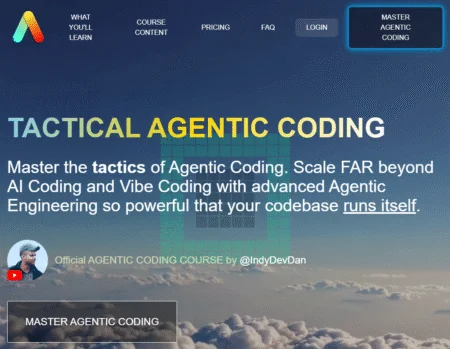
IndyDevDan – Tactical Agentic Coding – Agentic Engineer + Principled AI Coding Updated 2025
Artificial intelligence is transforming software development faster than any previous technological advancement. In 2025, the role of a developer is evolving into something more advanced: the Agentic Engineer. Rather than writing every line of code manually, today’s engineer orchestrates intelligent systems, designs automated workflows, and builds software that operates independently. This is not just about knowing a programming language — it’s about using AI tactically with engineering principles that ensure reliability, clarity, and performance.
This guide explores the complete path to mastering tactical agentic coding, including skill sets, frameworks, automation strategies, real-world deployment, and workflow enhancement with large language models (LLMs). Whether you’re a beginner trying to enter the AI space or an experienced developer upgrading for the future — this roadmap prepares you for the next era of engineering.
What Is Tactical Agentic Coding?
Tactical Agentic Coding means building systems that:
✔ Take initiative
✔ Reduce developer workload
✔ Automate complex processes
✔ Adapt to new data or goals
✔ Produce repeatable and traceable outcomes
Instead of acting like passive tools, these systems become independent actors capable of executing tasks intelligently. Developers no longer just write code — they supervise agents.
This shift changes everything about software engineering:
| Traditional Development | Agentic Development |
|---|---|
| Code flow entirely human-defined | Code flow partly auto-generated |
| Focuses on solving a single use-case | Adapts to multiple contexts |
| Execution must be monitored | Agents self-optimize & report |
| Weak automation | High autonomy |
The New Role of an Agentic Engineer in 2025
An Agentic Engineer must master three core responsibilities:
1️⃣ Automating workflows
Building multi-step systems where AI tools communicate, validate outputs, and complete tasks without constant oversight.
2️⃣ Applying principled coding
Even when AI writes code, humans enforce architecture patterns, testing discipline, readability, documentation, and security.
3️⃣ Engineering safe and reliable intelligence
Ensuring agents remain grounded in real objectives, with oversight and ethical guardrails.
Agentic Engineers are not just developers — they are system commanders guiding automated intelligence.
Key Skills You Must Learn To Stay Ahead
Here are the most valuable skills powering future engineering careers:
✔ Agentic Systems Design
Understanding how to break down workflows into autonomous tasks executed by agents.
✔ Prompt Engineering for Software Automation
Prompts that include:
Context
Coding rules
Expected output format
Validation conditions
✔ LLM-Driven Code Generation
Using AI as:
Code co-author
Debug assistant
Documentation producer
Testing partner
✔ API + Tool Integration
Connecting AI with:
CMS
Databases
Cloud buckets
Third-party services
CI/CD automation
✔ Observability and Feedback Loops
Every agent must:
Log decisions
Validate output
Request corrections if needed
This rigorous engineering mindset separates amateurs from professionals.
Principled AI Coding: Foundation of Reliability
Agentic development still needs strong traditional engineering fundamentals. Principles ensure correctness and maintainability even when AI assists in the coding.
Key principles include:
| Principle | What It Ensures |
|---|---|
| Modular Design | Agents operate independently |
| Type-Safe Code | Less failure risk |
| Version Control Discipline | Full traceability |
| Continuous Testing | Agents don’t break logic |
| Incremental Development | Visibility over evolution |
AI helps, but principles govern the system. Without discipline, automation becomes chaos.
How Autonomous Agents Work in Real-World Projects
Agents collaborate through a process:
Goal Input — User defines outcome
Task Planning — Agents strategize
Execution — Code runs independently
Self-Review — Agents inspect their own output
Iteration — Improvements applied
Final Output — Delivered result
Example:
“Create a Python script that uploads files to AWS S3 every night and sends a status report to Slack.”
A well-designed agent:
Writes the code
Deploys the script
Schedules automation
Tests outcomes
Confirms results
This is the future of DevOps + Software.
Tech Stack for Agentic Engineering in 2025
Core Technologies
Python & JavaScript
TypeScript & Rust for strong typing
FastAPI, Node.js, and serverless architectures
Agent Frameworks
LangGraph & LangChain
CrewAI and AutoGen
Local agent containers using Ollama
Workflow orchestrators like Airflow & Temporal
Deployment Tools
Docker, Kubernetes
Managed cloud AI platforms
Vector databases (Pinecone, Weaviate, Chroma)
Testing & Monitoring
Playwright, Pytest, Jest
Observability dashboards
Semantic evaluation metrics
This stack gives you unstoppable autonomy engineering power.
Career Opportunities for Agentic Engineers
Companies want devs who:
Automate repetitive tasks
Accelerate production cycles
Reduce human cost
Achieve high-quality output
High-demand roles include:
| Job Role | Salary Range (2025 Estimate) |
|---|---|
| Agentic Automation Engineer | $110k–$220k/year |
| AI Workflow Architect | $140k–$260k/year |
| LLM Application Developer | $100k–$200k/year |
| AI Reliability Engineer | $120k–$230k/year |
| AI Operations (AIOps) Specialist | $95k–$180k/year |
Companies adopt AI faster than ever. Talent shortage = massive opportunity.
Projects You Should Build To Learn Faster
✔ Email automation agent for customer support
✔ Code refactoring bot with PR automation
✔ Research assistant that collects and summarizes trends
✔ Data labeling + validation workflow tool
✔ Custom deployment agent for small apps
✔ AI-powered QA agent that auto-fixes failing tests
Each project shows practical skill and increases hiring strength.
Future Vision: AI as the Co-Engineer
By 2027, development becomes:
🔹 70% AI automated
🔹 30% human supervision and strategy
Developers who resist change fall behind. Those who embrace it become leaders.
AI won’t replace programmers — but programmers who master agentic systems will replace those who don’t.
Why Learning Agentic Engineering Now Matters
AI now creates full applications in hours, not weeks
Businesses demand higher output with fewer people
Skills grow more valuable as automation spreads
This is a once-in-history transformation era
The question is not whether this shift happens — only whether you’re prepared to benefit from it.
Final Thoughts
The skills involved in tactical agentic coding combine AI power with timeless programming principles. It’s the ultimate strategy for staying relevant and highly paid during the AI revolution.
To summarize your roadmap:
Learn how agents work
Focus on principled engineering
Automate everything possible
Build real workflow projects
Make AI your best co-developer
The future belongs to intelligent creators who understand both automation and structure.
Become one of them now.



Reviews
There are no reviews yet.