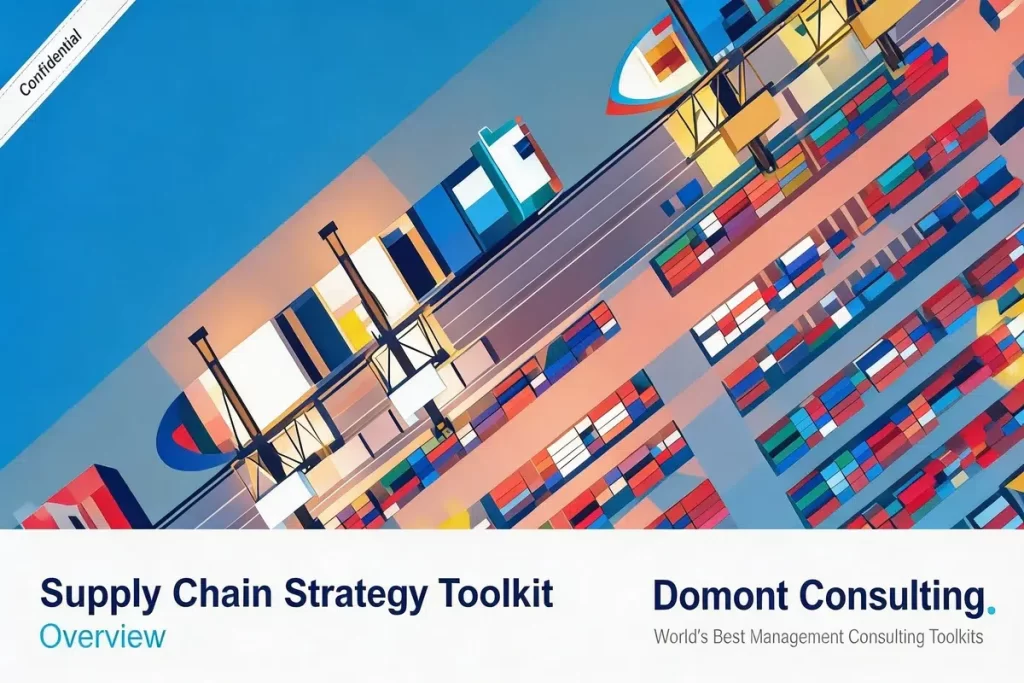
Domont Consulting – Supply Chain Strategy Toolkit
In today’s hyper-competitive and rapidly evolving business environment, supply chains are no longer just operational backbones—they are strategic assets. Organizations that treat supply chain planning as a long-term strategic function consistently outperform those that rely on reactive decision-making. This is where Domont Consulting – Supply Chain Strategy Toolkit emerges as a comprehensive and structured solution for businesses aiming to build resilient, cost-efficient, and future-ready supply chains.
This guide provides an in-depth explanation of what the toolkit offers, who it is designed for, how it works, and why it stands out as a practical framework for real-world supply chain transformation.
Understanding the Need for Strategic Supply Chain Planning
Modern supply chains face constant disruption from global uncertainties, shifting customer expectations, technology advancements, and cost pressures. Traditional planning methods often fail because they focus on short-term fixes rather than system-wide optimization.
A strategic toolkit enables organizations to:
Align supply chain operations with corporate objectives
Identify inefficiencies and hidden risks
Improve agility and responsiveness
Make data-driven, long-term decisions
Domont Consulting’s approach focuses on transforming supply chains from cost centers into value-creating ecosystems.
What Is the Domont Consulting Supply Chain Strategy Toolkit?
The toolkit is a structured collection of frameworks, analytical models, diagnostic tools, and implementation roadmaps designed to help organizations assess, redesign, and optimize their supply chains end-to-end.
Rather than offering generic advice, it provides:
Step-by-step strategic methodologies
Customizable templates for different industries
Decision-making tools grounded in real consulting experience
Clear execution pathways from strategy to implementation
This makes it suitable for both strategic planning teams and operational leaders.
Core Components of the Toolkit
1. Supply Chain Maturity Assessment
The first step in building a strong strategy is understanding the current state. The toolkit includes maturity assessment frameworks that evaluate supply chains across dimensions such as:
Planning and forecasting capability
Network design efficiency
Procurement and sourcing maturity
Inventory management effectiveness
Digital and analytics readiness
This assessment helps organizations identify gaps and prioritize improvement initiatives.
2. End-to-End Supply Chain Mapping
Visibility is the foundation of control. The toolkit enables organizations to map their entire supply chain—from suppliers to end customers—highlighting:
Material and information flows
Bottlenecks and delays
Cost leakages
Risk concentration points
This holistic view allows leadership teams to move beyond siloed optimization and focus on system-wide performance.
3. Strategic Network Design Frameworks
Network design plays a crucial role in cost efficiency and service levels. The toolkit provides analytical models to evaluate:
Warehouse and distribution center locations
Transportation routes and modes
Make-versus-buy decisions
Regional versus global sourcing strategies
By balancing cost, service, and risk, organizations can build robust networks that adapt to changing market conditions.
4. Demand Planning and Forecasting Alignment
Demand volatility is one of the biggest challenges in supply chain management. The toolkit emphasizes demand-driven planning by integrating:
Statistical forecasting techniques
Collaborative planning processes
Sales and operations planning (S&OP) frameworks
Scenario-based demand modeling
This alignment improves forecast accuracy and reduces inventory imbalances.
5. Inventory Optimization Models
Excess inventory ties up capital, while shortages damage customer trust. The toolkit includes proven inventory optimization methodologies that help:
Set optimal safety stock levels
Balance service levels with working capital
Reduce obsolete and slow-moving stock
Improve replenishment cycles
These models are adaptable across industries such as manufacturing, retail, and distribution.
6. Risk Management and Resilience Planning
Supply chain disruptions are no longer rare events. The toolkit embeds resilience into strategic planning through:
Risk identification matrices
Supplier dependency analysis
Contingency and redundancy planning
Stress testing under different disruption scenarios
This proactive approach helps organizations prepare for uncertainty rather than reacting to crises.
7. Digital Enablement and Analytics
Data is a strategic asset when used correctly. The toolkit supports digital transformation by guiding organizations on:
Selecting the right supply chain technologies
Leveraging analytics for decision-making
Integrating ERP, planning, and execution systems
Building KPI dashboards for performance tracking
This ensures technology investments directly support strategic objectives.
Who Should Use This Toolkit?
The toolkit is designed for a wide range of professionals and organizations, including:
Supply chain leaders and directors
Strategy and transformation teams
Operations managers
Consultants and advisors
Mid-size to large enterprises undergoing transformation
It is particularly valuable for organizations experiencing growth, restructuring, or increasing complexity in their supply chains.
Key Benefits of Using the Toolkit
Strategic Clarity
Provides a clear roadmap linking supply chain initiatives to business goals.
Cost Optimization
Identifies structural cost reduction opportunities beyond short-term savings.
Improved Service Levels
Enhances customer satisfaction through better planning and execution.
Risk Reduction
Builds resilience against disruptions and market volatility.
Faster Decision-Making
Enables data-driven decisions supported by structured frameworks.
Practical Application in Real-World Scenarios
One of the strengths of this toolkit is its practical orientation. It does not remain theoretical but focuses on:
Realistic implementation timelines
Stakeholder alignment strategies
Change management considerations
Performance measurement mechanisms
Organizations can apply the toolkit incrementally or as part of a full transformation program.
Why This Toolkit Stands Out
Unlike generic supply chain guides, this framework reflects deep consulting expertise and real-world application. It bridges the gap between strategy formulation and execution, ensuring that ideas translate into measurable outcomes.
Its modular design allows organizations to focus on priority areas while maintaining a coherent long-term vision.
Final Thoughts
A well-designed supply chain strategy is a competitive advantage that compounds over time. By using a structured and proven approach, organizations can move from reactive operations to proactive, value-driven supply chain leadership.
Domont Consulting – Supply Chain Strategy Toolkit serves as a powerful enabler for businesses seeking clarity, resilience, and sustainable performance in an increasingly complex global environment.




Reviews
There are no reviews yet.